When you hire an agency to build your website, it’s easy to assume everything — hosting, design, and even the domain name — belongs to you the moment you pay the invoice. But one of the most overlooked details in small business web projects is a simple question: whose name is the domain actually registered under?
At StudiosNext, we believe every client should own their domain outright, registered in their own name and their own account — not their agency’s. Here’s what that means, and why it matters more than most business owners realize.
What Is a Domain, Exactly?
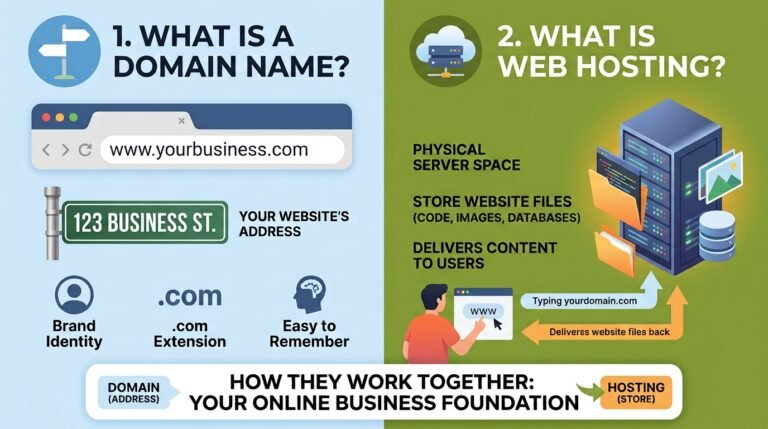
A domain is your website’s address on the internet — the part people type into a browser, like studiosnext.com. Think of it as the digital equivalent of your business’s street address or phone number: it’s how customers, search engines, and email systems find you.
A domain isn’t something you buy once and own forever, though. It’s more like a lease — you register it for a set period (usually 1–2 years at a time) through a domain registrar, and you renew it to keep using it. As long as renewals are paid, the domain stays active and pointed at your website.
How Domain Registration Actually Works
When a domain is registered, it’s tied to an account with a domain registrar (companies like Namecheap, GoDaddy, or Hostinger). That account has an owner on record — technically called the “registrant.” Whoever controls that account controls the domain: they can renew it, transfer it, redirect it, or even let it expire.
This is where things get important. If an agency registers your domain under their own company account “to make things easier,” you don’t actually own your domain — they do. You’re simply using it, dependent on their goodwill and continued business relationship to keep it.
5 Reasons Your Business Should Own Its Domain
1. Legal ownership follows the registrant, not the website
In most domain disputes, whoever is listed as the registrant is treated as the legal owner — regardless of who paid for the original setup or who built the website. If your agency’s name is on the registration and a disagreement ever arises, you may have very little legal standing to reclaim a domain that represents your entire brand.
2. You’re protected if the agency relationship ends
Agencies close, change direction, or simply become unresponsive over time. If your domain is locked inside their account, losing that relationship could mean losing your website, your business email, and years of SEO rankings overnight — with no easy way to get it back.
3. You avoid renewal and expiration risks
Domains that aren’t renewed on time can lapse — and once expired, they can be purchased by anyone, including competitors or domain squatters. When you own the domain directly, renewal reminders and billing go straight to you, so your business’s most important digital asset never depends on someone else remembering to pay a bill on your behalf.
4. It protects your business email and reputation
Most small businesses run their email (e.g., you@yourbusiness.com) through the same domain as their website. If you don’t control the domain, you don’t fully control your email either — and losing access to business email, even briefly, can mean missed client communication, failed password resets, and real reputational damage.
5. It preserves your SEO and marketing investment
Search engine rankings, backlinks, and years of Google trust are all tied to your domain — not your website design. If a domain has to be abandoned or rebuilt under a new address because the old one is inaccessible, all of that accumulated SEO value is lost, and you’re effectively starting from zero.
The Simple Fix
None of this requires distrust of your agency — it’s simply good practice, the same way you wouldn’t put your business bank account in someone else’s name for convenience. When starting a new project, make sure:
- The domain is registered under your business’s own name and email address
- You have direct login access to the registrar account
- Your agency is added as a manager/collaborator if they need access to make changes — not the account owner
A trustworthy agency won’t just accept this — they’ll recommend it.
At StudiosNext, we always register domains directly in our clients’ names, because we believe your website, your domain, and your online identity should always belong to you — not us.