If you’ve been shopping around for a new website, you’ve probably seen the phrase “SEO-optimized website” in almost every agency’s pitch — including ours. But it’s one of those terms that gets used so often, it’s easy to nod along without really knowing what it means, or how to tell if you’re actually getting it.
Here’s what an SEO-optimized website really involves, broken down into the two pillars that matter most: technical SEO and on-page SEO.
What Does “SEO-Optimized” Actually Mean?
At its core, an SEO-optimized website is one that’s built — from the ground up — to be easily found, understood, and ranked by search engines like Google, while also giving visitors a fast, smooth experience once they arrive.
It’s not something added on after a website is finished. A truly SEO-optimized site has search engine best practices built into its structure, code, and content from day one — which is exactly why it matters who builds your website, not just who manages your marketing afterward.
SEO-optimized websites are generally judged on two categories of work: what happens behind the scenes (technical SEO) and what happens on the actual pages people read (on-page SEO).
Technical SEO: The Foundation Search Engines Rely On
Technical SEO covers everything about how your website is built and how well search engines can access, read, and rank it. Even the best-written content can struggle to rank if the technical foundation underneath it is weak.
Key elements of technical SEO include:
- Site speed — how quickly pages load, since slow websites are penalized in rankings and lose visitors before they even see your content
- Mobile-friendliness — the site displays and functions properly on phones and tablets, which is how the majority of local searches happen
- Secure connection (SSL/HTTPS) — your site uses
https://rather thanhttp://, which Google treats as a baseline trust signal - Clean site structure — logical navigation and internal linking so both visitors and search engines can easily find every page
- XML sitemap — a file that tells Google exactly which pages exist on your site and helps it index them properly
- Crawlability — making sure search engines aren’t accidentally blocked from reading key pages (a surprisingly common issue on poorly built sites)
- Structured data (schema markup) — code that helps Google understand what your content actually is (a business, a review, a product, an FAQ), which can improve how your site appears in search results
- Broken links and errors — a technically sound site is regularly checked for 404 errors and broken pages, which otherwise hurt both user experience and rankings
Think of technical SEO as making sure the building itself is structurally sound before worrying about how the rooms are decorated.
On-Page SEO: Making Each Page Actually Rank
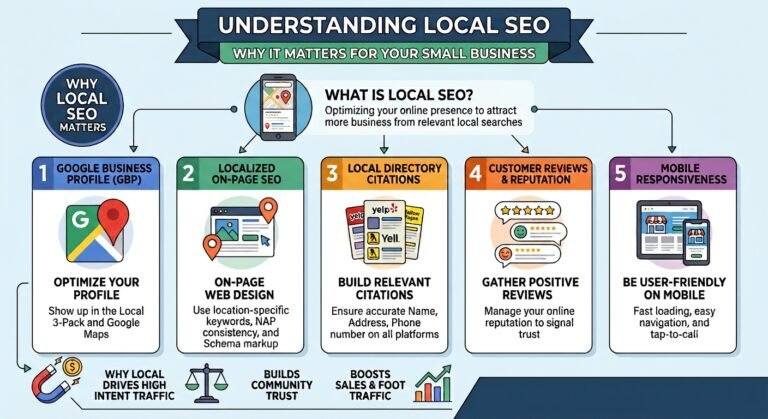
On-page SEO is about optimizing the actual content and elements of each individual page so it targets the right searches and gives both users and search engines a clear, useful experience.
Key elements of on-page SEO include:
- Keyword-focused content — each page is written around the specific words and phrases real customers search for (e.g. “plumber in [town]” rather than vague, generic phrasing)
- Title tags — the clickable headline shown in Google search results, written to be both keyword-relevant and compelling enough to earn the click
- Meta descriptions — the short summary shown under the title in search results, written to accurately represent the page and encourage clicks
- Header structure (H1, H2, H3) — content is organized with clear headings, which helps both readers scan the page and helps search engines understand its structure
- Image alt text — descriptive text attached to images, which helps accessibility and gives search engines context they can’t get from a picture alone
- Internal linking — pages link to other relevant pages on the same site, helping visitors navigate and helping search engines understand how content is related
- URL structure — clean, readable URLs (e.g.
/services/local-seo) rather than long strings of numbers and symbols - Content quality and length — pages that genuinely answer a visitor’s question in depth tend to outperform thin, vague content, especially for local service businesses
Where technical SEO is the foundation, on-page SEO is what actually earns rankings for the searches your business cares about — the local plumber wanting to rank for “emergency plumber near me,” or the salon wanting to show up for “hair salon in [town].”
Why Both Matter Together
A common misconception is that fixing one solves the other — it doesn’t. A site can be technically flawless (fast, secure, mobile-friendly) but still rank poorly if the content isn’t targeted to real search terms. Equally, a page can be perfectly written and keyword-targeted, but never get seen if the underlying site is slow, broken, or blocked from being properly indexed.
That’s why, when we say a website is “SEO-optimized,” we mean both layers are handled — the technical groundwork and the on-page content — working together rather than one propping up the other.
What This Means for Your Website
If you’re evaluating a new website (or wondering whether your current one is actually optimized), it’s worth asking directly:
- Is the site built to load quickly and pass Google’s mobile-friendliness checks?
- Does it use HTTPS and have a clean, error-free structure?
- Is each page’s content actually written around real search terms your customers use — or just generic descriptions?
- Do pages have proper title tags, meta descriptions, and header structure?
A website that ticks both the technical and on-page boxes isn’t just online — it’s actually positioned to be found by the customers already searching for what you offer.
Every website we build at StudiosNext is developed with technical and on-page SEO built in from the start — not bolted on afterward — so your site is ready to be found from day one.